
Ages 12–18 · 6–12 months
Build the portfolio that speaks for itself.
A studio-based pathway where students develop original work, learn to critique and refine it, and graduate with an application-ready portfolio — the way leading art schools teach.
Is this your child?
Who it's for
- Students aged 12–18 preparing for art and design school applications
- Beginners are welcome — the pathway starts with a foundations phase
- Students who want a real body of work, not a rushed folder of exercises
Not for you if…
- Families looking for a quick folder of exam-style drawings
- Students not ready to have work discussed openly in critique
- Four-weeks-to-deadline rescues — the honest answer is no
We would rather turn work away than take it dishonestly — that’s the deal behind every program here.
The GaiaX curriculum system
Find your X Factor, by design.
Our art and design curriculum runs on the Double Diamond — the design model professional studios use worldwide. Two rounds of divergence, two of convergence: discover widely, define sharply, develop boldly, deliver precisely.
DiscoverDivergeCast wide — references, questions and unexpected inputs, before any settling.
Laid end to end, the four phases draw an X — the X in GaiaX. The method is the name.
Diverge
Discover
Open the question wide. Primary and secondary research around the brief — and around the student's own interests.
Converge
Define
Cluster, distil, decide. Insights become themes; themes become one sharp “How might we…” brief.
Diverge
Develop
Many ideas, made fast. Ideation rounds and honest evaluation — directions chosen on evidence, not habit.
Converge
Deliver
Build, test, iterate. Prototypes tighten into finished work that survives critique — and carries the application.
Five levels, one method.
Art Exploration
Design Foundations & Creative Work
Advanced Projects
Professional Projects & Interdisciplinary Workshops
Artistic Expression
Each level works the same professional method at greater depth — from a student’s first exploration to application-ready mastery — so skills stack instead of scatter. The point is never to imitate a style. It is to build each student’s own thinking system: the X factor admissions tutors remember.
What it feels like
A typical session.
No mystery: this is how the time is actually spent, week after week.
- 15 minWarm-up drawing — hands and eyes before anything else
- 15 minBrief and demonstration for the day's problem
- 60 minStudio time: making, with one-to-one coaching rounds
- 20 minGroup critique — every student shows, every student speaks
- 10 minNext-week plan noted in the student's log
The plan
The journey, milestone by milestone.
Published before we start. You always know where your child is.
- 01
Month 1 · Diverge
Discover
Research wide: the brief, the field, and the student's own interests — primary and secondary research together. Output: research file and direction options.
- 02
Month 2 · Converge
Define
Synthesis: cluster topics, extract insights, set themes, land on one sharp 'How might we…' brief. Output: the final brief that guides the studio months.
- 03
Months 3–5 · Diverge
Develop
Ideate and make: many directions tried fast, evaluated honestly in weekly critique, the strongest developed into finished works. Output: three to five developed projects, each yielding finished pieces and process pages.
- 04
Month 6+ · Converge
Deliver
Build, test, iterate to final: sequencing, artist statement, mock review, public exhibition, photography. Output: an application-ready portfolio and an exhibition record.
Who teaches this
Standards, not mystery.
Practising artists and design-trained educators who run critique the way art schools do — openly, specifically, kindly. Every mentor teaches to published milestones and is reviewed each season on student work and parent feedback.
Every family meets the mentor before the program starts — named, in person or on a call. No ghost professors, ever.
What your child takes away
- Application-ready portfolio
- 3–5 in-depth projects — typically 15–25 portfolio pages of finished and process work
- Artist statement
- Critique and process records
- Public exhibition experience
Pairs with: Start here for art-school routes; pairs well with AI Research or Robotics
We publish what we practise
Read how we think first.
Free guides from this program's playbook — judge the thinking before you book anything.


What's included
The structure, before you commit.
- Mentor-led sessions on a published schedule
- Studio or lab time at our Singapore campuses
- Weekly critique and honest review
- Published milestones — the plan before we start
- Progress and work-in-progress updates for parents
- The deliverables on this page — finished, kept, archived
Every pathway is tailored.
Duration, depth and coaching are shaped around your child’s starting point and goals. We’ll walk you through the structure — and the investment — in your consultation.
Straight answers
Questions parents ask.
How many hours a week does it take?
A sustainable default: one studio session plus focused making time between critiques — enough to finish work without sinking school. The exact rhythm is set in your plan, and it bends around exam blocks rather than the other way round.
Digital or traditional — which should the portfolio be?
Whichever the work honestly needs; strong sets usually hold both. Schools read fundamentals through any medium — observation, ideas, process. Tools are chosen per project, not declared upfront.
How long does the pathway take?
Six to twelve months for the full journey. A shorter sprint is only honest when a substantial body of work already exists — we tell you which one your child needs in the first consultation.
Does my child need prior art training?
No. The pathway begins with a foundations phase. What matters is interest and commitment.
Do you guarantee admission to art schools?
No. What we build is the strongest possible evidence: work refined through weekly critique until it can speak for itself.
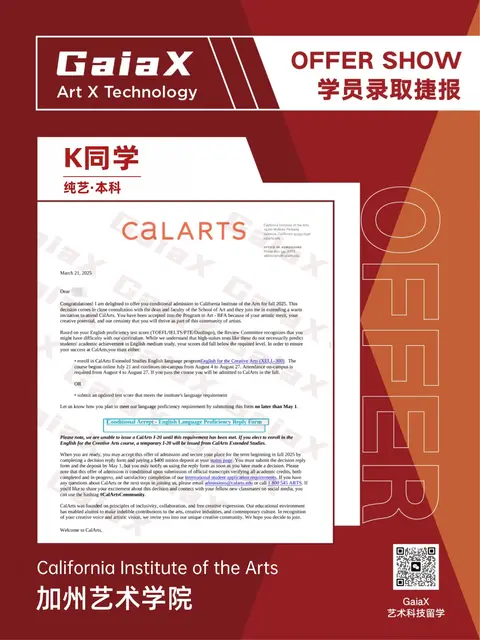
Offer show · Fall 2026
Where this work just landed.
Real offers from the current intake — posters shared as issued, names withheld.



Often paired with
Where this fits in the pathway.
Start here for art-school routes; pairs well with AI Research or Robotics
Ready to talk?
Tell us about your child and we'll map out where this program fits.
New here? Every age group can book a free trial class on WhatsApp first.